
Searching Sherman County Criminal Dockets
Two free doors open the search. One is the public JUSTICE one-time search. The other is the free JUSTICE terminal inside the Sherman County Courthouse. JUSTICE covers County Court and District Court records across Nebraska. For remote one-time use, the official product charges $17. It returns up to 30 records, and keeps results viewable for three calendar days. Its own instructions tell you to search a party, never a witness. Heavy repeat users buy a subscriber account instead.
Enter a full party name or the exact case number. When the live interface allows, narrow by Sherman County, court type, year, CR case type, judge, or attorney. The statewide calendar can confirm a current hearing. But the Register of Actions is where the filing history lives. Paper-only items, certified copies, and anything missing online go through the County Court Clerk Magistrate or the Clerk of the District Court. It depends on case level.
- Choose JUSTICE or the Sherman County public terminal, then select the proper court level.
- Search the exact party name or criminal case number and narrow to Sherman County.
- Open the case summary and read charges, counts, settings, and the Register of Actions.
- Use the calendar for a future event, then verify a time-sensitive setting with the clerk or written notice.
- Request a named record from the court that holds the file when an image or certification is needed.
Sherman County Criminal Case Codes
A Sherman County criminal case number tells you which court holds the file. Learn that before you run a broad name search. The leading letter does that work. A C means County Court, and a D means District Court. The county component is 82, and CR marks the case as criminal. Put together, the official number looks like C82 CR-YY-identifier or D82 CR-YY-identifier. Those are the structure's parts, not a real case. One caution: a C prefix does not lock every later felony action into County Court.
When a name search pulls too many results, narrow it. Use the court prefix, county, year, and case type together. New filings may lag by roughly 24 hours in the official one-time product. So give a fresh record a day to appear. If the case still does not show up, ask the clerk a few things. Does the file sit at the other court level? Could it exist only on paper, be restricted or sealed, or have passed out of a retention schedule? A blank search means the access path needs checking. It does not mean no case exists.
Note: The number format identifies routing details only. It does not state the outcome, current status, or identity of a party.
Inside a Sherman County Criminal Docket
A JUSTICE criminal record can carry a lot: case summary fields, court and case number, party roles, offense details, counts, the filing or charge date, a scheduled event, the Register of Actions, judgment or disposition, financial assessments, payment activity, public document-image links, and judge notes where they apply. Not every field shows up every time. Read only what the court actually entered, and infer nothing beyond that entry.
| Case Number | Shows the court prefix, Sherman County number, criminal type, year, and identifier. |
|---|---|
| Offense Information | Criminal-only fields may identify charges, count labels, and status information. |
| Hearing Settings | Lists scheduled events such as arraignment, pretrial, trial, or sentencing when present. |
| Register of Actions | Records dated filings, hearings, orders, and other procedural actions. |
| Disposition | Shows the court-recorded result for a case or count, not an assumption drawn from a payment. |
| Financial Activity | Shows assessed and paid information, which is distinct from the legal disposition. |
One caution worth repeating. A charging document and a Register entry are different record types. In the same way, a paid balance is not automatically a disposition, and one dismissed count does not dismiss the whole case.
Sherman County Felony Docket Route
Sherman County Court handles misdemeanors, traffic infractions, and preliminary hearings in felony cases. Felony trials belong to Sherman County District Court. So a felony can leave a preliminary-hearing record in one court and continue in the other. When a County Court entry points to later proceedings, look for the District Court companion. Or look for a later case number. The preliminary-hearing entry is not the final felony record.
Appeals run through a different door entirely. Nebraska Court of Appeals and Nebraska Supreme Court records come through SCCALES. That is not another Sherman County trial-court search. Federal criminal cases sit elsewhere too, in PACER. Keeping these boundaries straight keeps an incomplete search from masquerading as a complete procedural history.
The official Sherman County District Court page identifies the district-level court. That court holds the felony trial records.
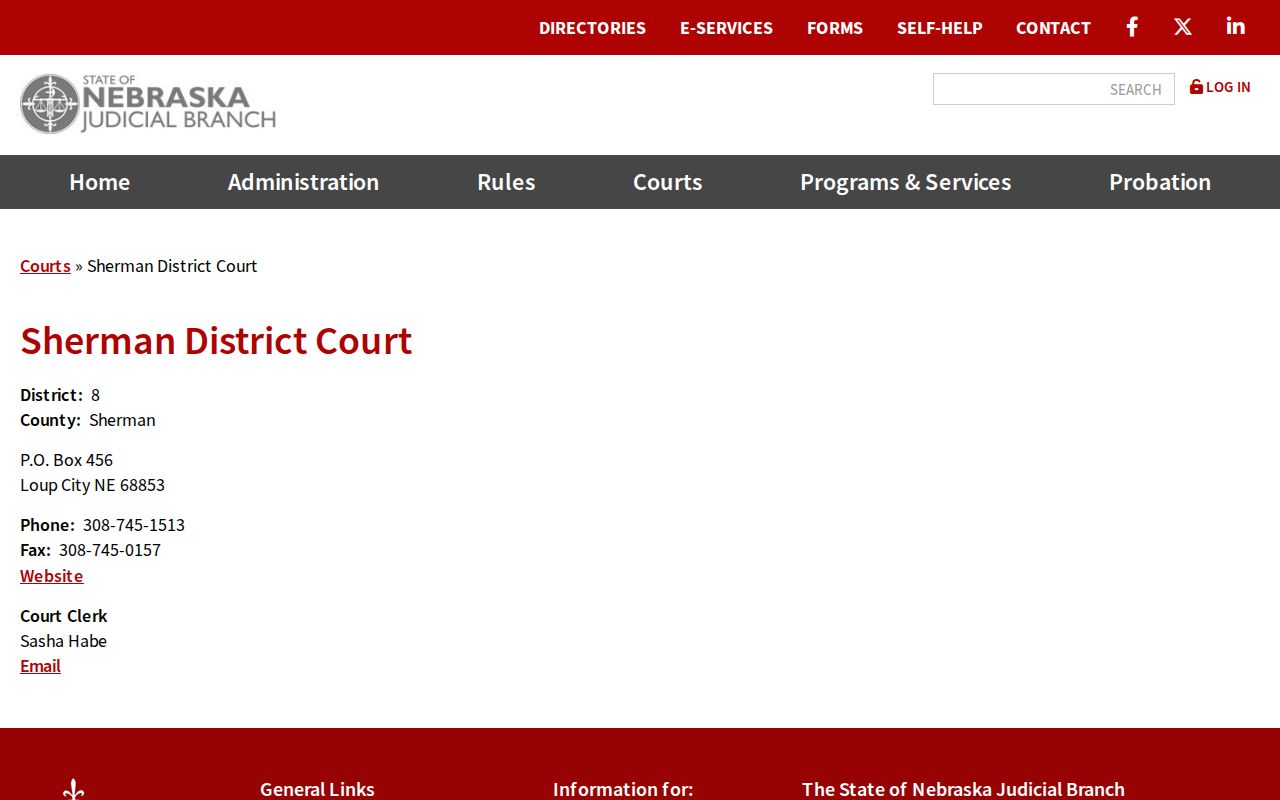
The District Court page confirms the local split. A preliminary County Court record and a District Court felony docket are two distinct things, and the second is where the felony trial record lives.
How a Criminal Case Moves
A Sherman County criminal docket may run through many stages. Those include filing, arraignment, pretrial settings, plea or trial, disposition, and sentencing. Cases skip steps and shuffle the order. The Register of Actions gives the true timeline for the specific matter. The calendar lists a scheduled hearing. But a listing proves neither that the hearing happened nor that the case ended.
Docket flow: Filing → Arraignment → Pretrial → Plea or Trial → Disposition → Sentencing
Trust the actual docket label. Filed, pending, scheduled, continued, plea entered, waiver accepted, dismissed, acquitted, convicted, judgment entered, sentence imposed, and case closed are all different events. Confirm warrant status with the clerk. A payment alone is not a recall or a court disposition unless an entry says so.
Sherman County Criminal Docket Terms
The terms in a Sherman County criminal record name procedural events, not people. Read them in the order recorded, and a hearing date stays separate from a ruling, a payment event separate from the outcome. The official record decides which label applies.
- Count
- A separate alleged violation within a criminal case.
- Preliminary hearing
- The County Court felony-stage hearing that addresses probable cause before District Court proceedings.
- Continuance
- A postponement or rescheduling of an event.
- Waiver
- An eligible procedure allowing disposition without an in-person appearance, subject to court acceptance.
- Judgment
- The court's formal adjudication or order resolving an issue or case.
Docket shorthand gets more useful the busier a case becomes. When a Sherman County criminal docket stacks up multiple counts or a string of hearings, a one-line status can hide as much as it shows. Read the matching order, or ask the clerk for the specific public document, before drawing a conclusion from a short entry.
Courts That Hold Criminal Dockets
Sherman County splits its criminal dockets between two courts. County Court handles misdemeanors, traffic infractions, and felony preliminary hearings. District Court takes felony trials and the criminal matters assigned to that level. JUSTICE, the statewide case system, lists public trial-court cases at both levels. Even so, each clerk keeps the records for that court alone. Two names matter here. Janelle Mostek, County Court Clerk Magistrate, answers criminal and traffic questions for County Court. Sasha Habe, Clerk of the District Court, handles felony records. Both offices sit in the same courthouse and share one general phone number. But their fax numbers differ. Put the case number, party name, court level, and the document you want in any request. Say whether you need a plain or certified copy. The official Sherman County Court page spells out County Court jurisdiction. That covers criminal and traffic cases at this level.
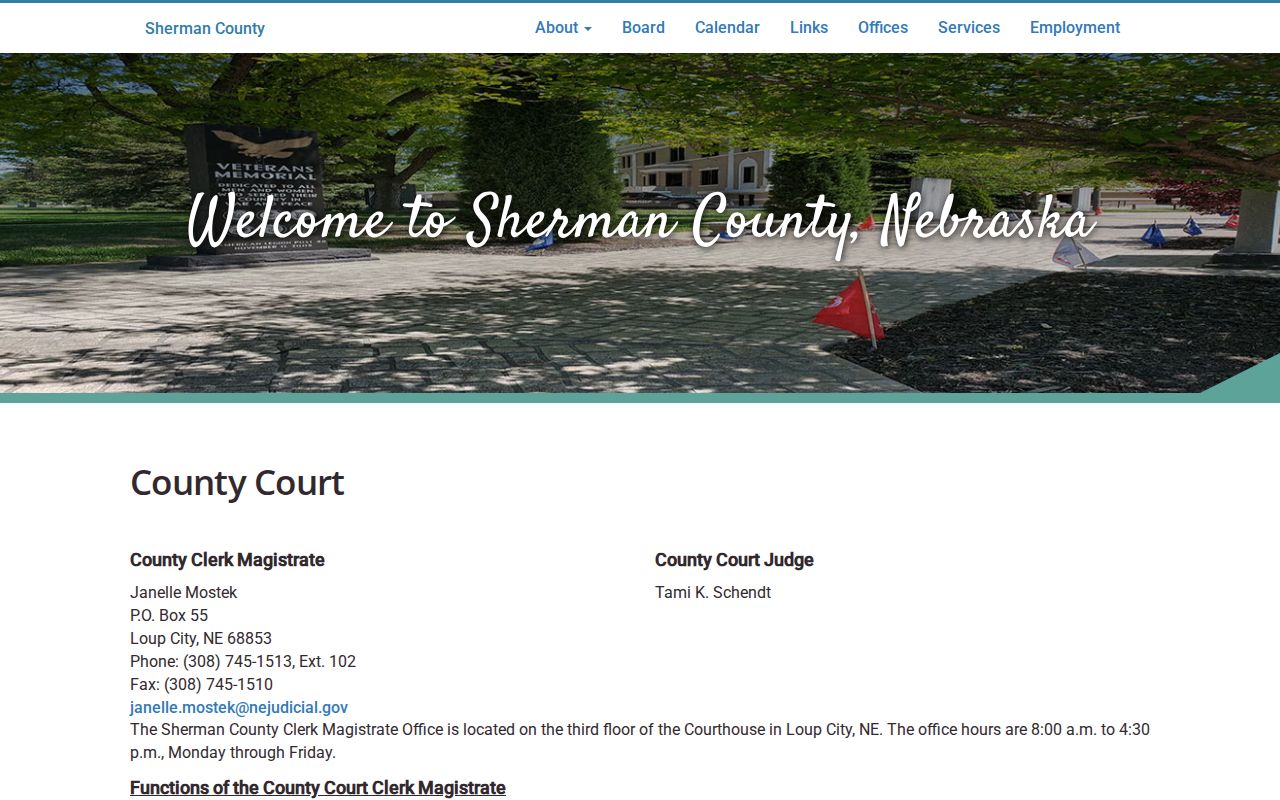
The County Court details point to one practical rule. A Sherman County criminal docket search starts with the case type and court level, not with a city name or a payment receipt.
Sherman County Criminal Clerk Channels
Each access channel does a different job. Online, that means JUSTICE, the statewide calendar, payment and waiver information, and subscriber access. In person, use the courthouse public terminal or the clerk counter. Phone, mail, fax, and County Court email all work. Each reaches a clerk about a named case or document. A formal written public-record request follows the Court Records Search Policy. That policy routes the Nebraska Open Records Act channel through the State Court Administrator. The two clerks have separate mailing details. County Court Clerk Magistrate: P.O. Box 55, Loup City, NE 68853, direct phone 308-745-1513 ext. 102, fax 308-745-1510, and the email address listed on the county court page. District Clerk: P.O. Box 456, Loup City, NE 68853, general phone 308-745-1513, fax 308-745-0157. Attorneys and authorized filers go through Nebraska Trial Court eFiling. Everyone else uses JUSTICE or the clerk. An official District Court clerk directory lists the separate Sherman County clerk contact channel.
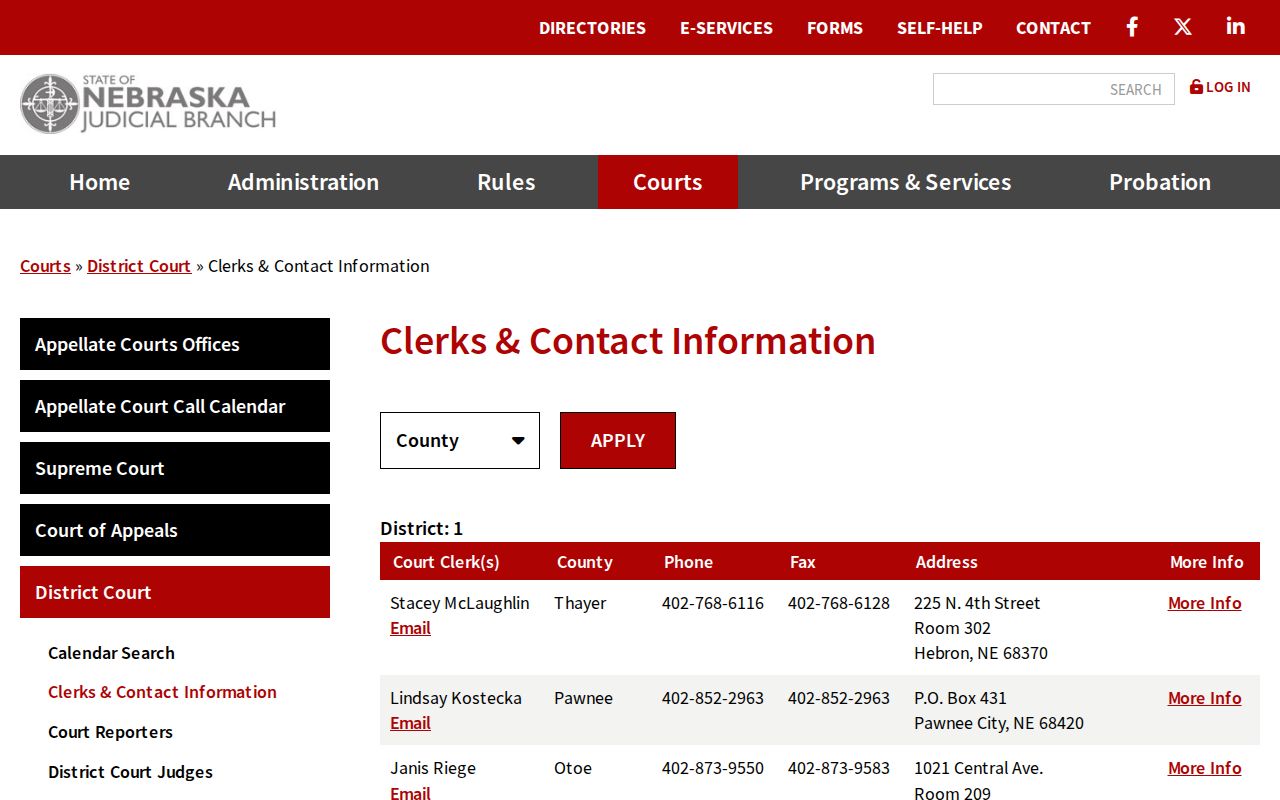
The shared courthouse can mislead people. Use each court's own address and fax for a Sherman County criminal docket request, because the two file routes are not interchangeable.
Sherman County Criminal Search Fallback
A Sherman County docket search can come up empty for small reasons. Before widening it, check commas and spacing in the party name. Check the middle initial, the court level, the year, and the CR case type too. The calendar has quirks of its own. It only covers current or future settings. It also needs at least two last-name characters in that mode. A blank calendar proves nothing about whether a hearing exists. When the filing level is unclear, run both County Court and District Court. For an older or exact record, call or visit the clerk. Bring the case number and your document request. Ask whether the item is indexed, publicly imaged, paper-only, restricted, sealed, or gone under retention rules. The court search policy lets a clerk help with a specific record. It bars a certificate that a search turned up no record at all. That line matters: an incomplete electronic result is never a final criminal-docket conclusion.
Sealed Dockets and Public Access
Nebraska opens many criminal records to the public, within the categories the court rules allow. Confidential, sealed, redacted, juvenile, and restricted records stay closed regardless. The public terminal does not get around those limits. A missing image can simply mean a document is old, unscanned, restricted, or sealed. Ask the right clerk about the procedural route for a specific file. The clerk can explain the process. But the clerk never gives legal advice.
Key Rules:
Neb. Ct. R. §1-805 identifies public electronic record categories unless another rule limits access.
Neb. Ct. R. §2-210 governs redaction, confidential treatment, and records filed under seal.
Neb. Rev. Stat. §84-712 covers public examination and copying during office hours, subject to exceptions.
Sealed records have their own state process. It applies only to an eligible person. It runs through the court where the case was filed. For a public criminal document that still will not appear, ask the clerk. Ask about imaging, paper storage, access limits, and retention. Treat a blank Sherman County docket search as a search result, not a case finding.